

OET Exam Preparation: What You Need to Know
If you are a healthcare professional planning to work or study where English is used in clinical practice, you may need to demonstrate your communication skills. The Occupational English Test (OET) is designed around healthcare situations, from understanding a patient consultation to writing a professional letter. Good OET exam preparation helps you become familiar with the test and communicate more clearly in the workplace.
This guide explains the four OET sections, how results work, and how to build a practical study plan in Saudi Arabia.
What Is the OET Exam?
OET is an English language test for healthcare professionals. It measures how well you listen, read, write, and speak in situations connected to healthcare. The Writing and Speaking tasks reflect the profession you select when booking. However, a familiar clinical setting does not make the test a medical knowledge exam: you are assessed on your English communication.
Before registering, check whether the regulator, employer, university, or visa authority you plan to apply to accepts OET for your profession. Confirm its required scores and any rules about combining results from different sittings. Requirements differ between organisations and can change.
What Are the Four OET Sections?
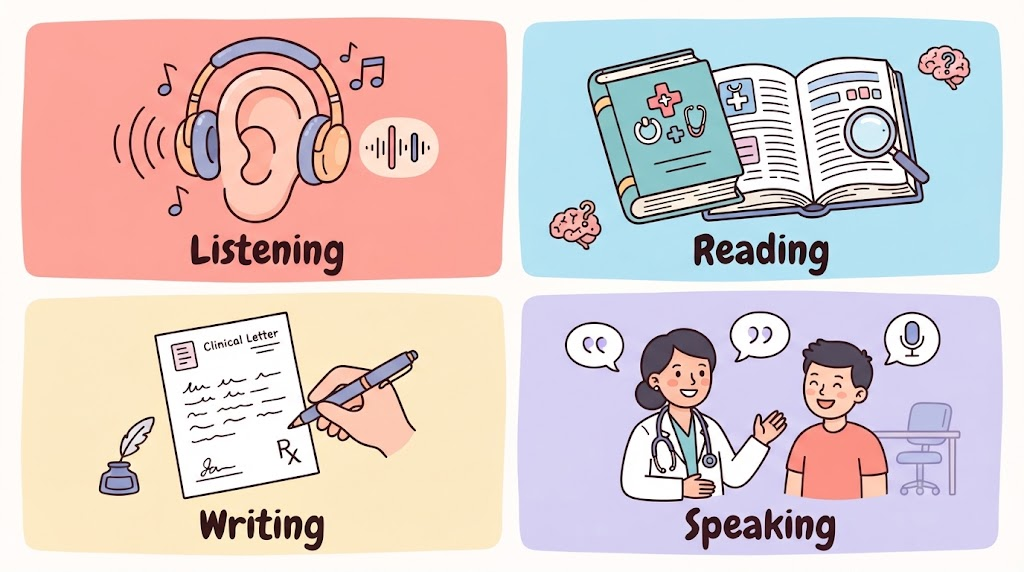
Listening
The Listening sub-test takes approximately 45 minutes. You hear healthcare-related recordings and answer questions about consultations, workplace conversations, and presentations. Practise identifying key facts, following changes in a speaker’s meaning, and listening for detail without losing the overall message.
Reading
The Reading sub-test takes 60 minutes. It tests how efficiently you can locate information and understand healthcare texts. Timed practice is valuable because you need to move between quick searches for facts and careful reading for meaning.
Writing
The Writing sub-test takes 45 minutes, including time to read the case notes. You produce a healthcare letter for a specific reader and purpose, such as a referral or discharge letter. Strong answers select relevant information, organise it logically, and use a professional tone. Copying every detail from the notes makes the letter less useful to its reader.
Speaking
The Speaking sub-test takes about 20 minutes. You complete two role-plays that simulate conversations with a patient or a patient’s relative. Clear explanations, empathy, appropriate questions, and a well-managed conversation matter. Practise speaking naturally rather than memorising a script.
How Is OET Scored?
OET reports a separate score for each of the four sub-tests on a scale from 0 to 500, alongside a letter grade from A to E. Grade B starts at 350. There is no single passing score that applies to every destination or profession. Your target is the requirement set by the organisation receiving your result, so check that requirement before deciding when to sit the test.
Likewise, do not assume that every OET result has one universal expiry date. The organisation you apply to decides how recent your results must be.
How to Prepare for the OET Exam
1. Start with your target and a diagnostic test
Write down the scores you need in each section. Then complete a timed sample test to see where you stand. Separate language gaps from test technique: for example, you may understand a text well but struggle to finish the Reading section on time.
2. Practise with official materials
Use OET sample tests for your profession and your planned test mode where available. Review the answer keys and task instructions rather than simply repeating tests. This helps you understand what each question requires and how to improve after a mistake.
3. Give Writing and Speaking regular attention
These sections benefit from specific feedback. For Writing, check whether the letter addresses its reader, includes the right details, and is easy to follow. For Speaking, record practice role-plays and listen for clarity, pacing, empathy, and missed opportunities to check understanding.
4. Work under timed conditions
Untimed exercises build skills; timed practice shows whether those skills hold up during the exam. Plan regular full-length practice sessions, then review the errors that cost you the most marks.
5. Build useful healthcare English habits
Listen to clinical discussions, read healthcare information intended for different audiences, and practise explaining technical points in plain language. A patient and a fellow professional may need the same information expressed differently.
A Simple Four-Week OET Study Plan
Week 1: Confirm your target scores, complete a diagnostic test, and learn the format of all four sections.
Week 2: Practise Listening and Reading under time limits. Review incorrect answers and note recurring vocabulary or comprehension problems.
Week 3: Focus on writing letters and speaking role-plays. Seek feedback and rewrite or repeat tasks after making corrections.
Week 4: Complete full timed practice tests, review your weakest section, and confirm your booking, ID, venue or computer requirements, and test-day instructions.
The time you need may be shorter or longer depending on your starting level and target scores. Use your practice results to adjust the plan.
How to Book OET in Saudi Arabia
Book through the official OET test booking page. Search for your location, available dates, and offered test modes. Check the current identification requirements and use the same personal details on your booking and accepted ID. Test availability can vary by location, so verify your preferred option before making travel plans.
OET results are issued for each sub-test. Publication times depend on the test mode and other factors; consult OET’s current results guidance when planning an application deadline.
OET Preparation in Riyadh with Skills Zone Training

Independent study can help you learn the format, but feedback can show you exactly where your communication needs work. Skills Zone Training’s OET preparation in Riyadh covers Listening, Reading, Writing, and Speaking through interactive sessions and mock tests. The centre also offers weekday and weekend class options and an initial consultation to discuss your level and goals.
If you are preparing for OET in Saudi Arabia, contact Skills Zone Training to discuss the course schedule and a study plan suited to your target scores.
Frequently Asked Questions
Is OET only for nurses?
No. OET is designed for multiple healthcare professions. Select the correct profession when booking and check that your receiving organisation accepts the test for your role.
Is OET easier than IELTS?
That depends on your English skills and experience. OET uses healthcare contexts, which may feel familiar to clinicians, but you still need to meet the English standard required by your receiving organisation.
What score do I need to pass OET?
There is no universal pass mark. Grade B begins at 350, but required scores vary by regulator, employer, programme, and profession. Check the exact rules for your intended application.
Can I take OET in Riyadh?
Search Riyadh on OET’s official booking page to see currently available venues, modes, and dates. Preparation classes and the official exam are separate services.
How long should I prepare for OET?
Start with a diagnostic test. Your preparation period should reflect your present level, target scores, and the time you can practise each week consistently.
Start with a Clear Plan
Effective OET exam preparation begins with three steps: confirm your destination’s requirements, identify your weakest skills, and practise in the format you will take on test day. With a focused plan and useful feedback, you can approach each sub-test with greater confidence.
For support in Riyadh, explore Skills Zone Training’s OET course or get in touch to discuss your next step.